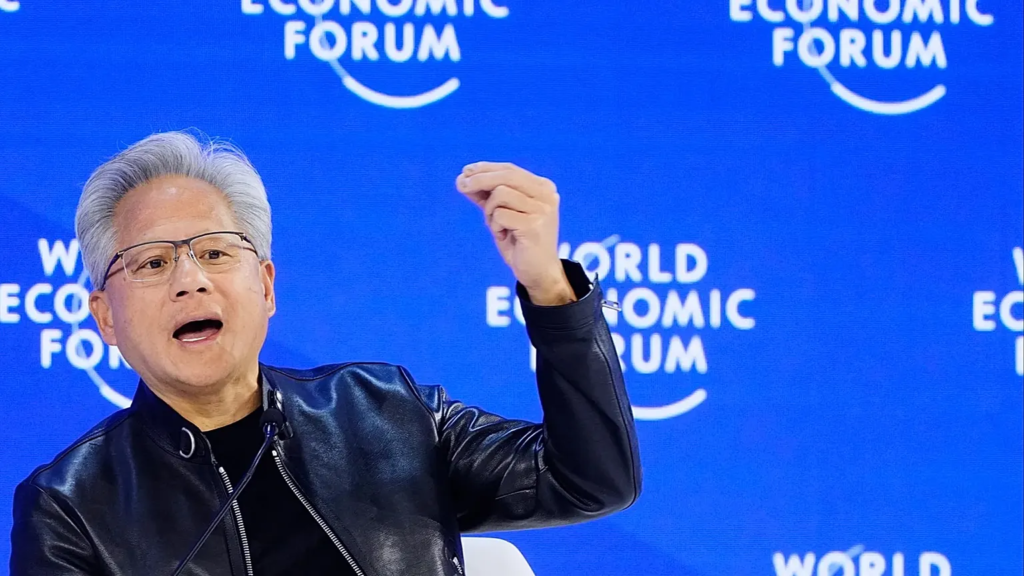
At Davos 2026, one of the most insightful conversations came from NVIDIA CEO Jensen Huang, who offered a grounded and practical way to understand what is really happening in the AI revolution. Far from focusing on chatbots or image generators, Huang framed AI as a massive infrastructure transformation—one that is already reshaping economies.
Huang described AI as a five-layer stack. At the foundation is energy, followed by chips and computing hardware, then cloud infrastructure, AI models, and finally the application layer, where real economic value is created. While applications attract the most attention, Huang stressed that none of them can exist without enormous investment in the lower layers. According to him, hundreds of billions have already been spent, with trillions more required.
This scale helps explain why concerns about an “AI bubble” may be misplaced. Huang pointed to a simple indicator: the shortage and rising rental prices of GPUs, including older generations. That kind of demand signals real usage and supply constraints, not speculative excess.
He also highlighted how today’s AI differs from traditional software. Instead of following rigid, pre-written instructions, modern AI systems can understand unstructured data—images, text, sound—and reason in real time. As Huang put it, AI is no longer programmed in the classic sense; it is trained and taught, which fundamentally lowers barriers to innovation.
Three recent breakthroughs, in his view, accelerated AI’s shift into a true economic force: more reliable and grounded models, the rise of open reasoning models, and the emergence of physical AI—systems that can understand proteins, materials, and real-world physics. These advances are already transforming fields like manufacturing, robotics, and drug discovery.
For Europe, Huang saw a clear opportunity. With its strong industrial and scientific base, Europe is well positioned to lead in physical AI—if it invests seriously in energy and infrastructure. Without that foundation, regions risk becoming users of AI rather than builders of it.
The key takeaway from Davos was clear: AI is not just a software trend. It is the beginning of one of the largest infrastructure buildouts in modern history, and the decisions made today will determine who truly benefits from it tomorrow.